


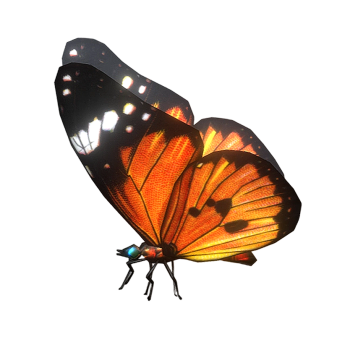
Golden Spot Butterfly (3D animated model)
The golden spotted butterfly is an insect of the genus Spotfly of the family Spotfly in the order Lepidoptera. The cephalothorax is black with white spots on it. The wings are orange-red, the front edge and outer edge of the front wing are black, the wing end is a black area, there are 4 oblique bands composed of white spots in it, and the outer edge has 2 rows of small white spots. The outer edge of the hindwing is black, with 1 row of small white spots on it and 3 black spots on the middle chamber end. The reverse is similar to the front, but the outer edge, white halo around black spot at middle chamber end. The life span of male adults is 168.65-384.66 hours, and that of female adults is 288.43-624.67 hours.

Butterfly 3D Model Animation FBX Model

Taiwan Star Butterfly 3D animation model
Taiwan star butterfly, also known as star point butterfly, belongs to the butterfly family, is a small insect. Mainly distributed in China Taiwan, Fujian, Guangdong, Hainan and other regions. The wings have beautiful star markings, hence the name "Star Nong Butterfly". The mouthpart is long and thin, suitable for absorbing pollen and nectar, so it is often regarded as one of the pollinators of plants. Like to grow in a warm and humid environment, mainly in the mountains or hilly areas, often perched in the flowers. An insect that is active during the day and likes to dance among the flowers. The host plants are mainly grasses. The larvae feed on the leaves of the host plant and the adults on nectar

Ash Butterfly
Belonging to some small butterfly species in the family Lycaenidae, they are known for their soft gray, white, or brown wings and unique markings. The Grey Butterfly family is one of the largest families of butterflies, widely distributed and diverse worldwide. Larvae mainly feed on the leaves of various plants, while adults feed on nectar. Plays an important role in the ecosystem as a pollinator, promoting plant reproduction, and also serves as a food source for many bird and other insect predators. Eggs are usually laid on the leaves of the host plant. After hatching, larvae begin to feed and undergo several molts before entering the pupal stage, eventually emerging into adults.

Orange Pink Butterfly
A butterfly belonging to the family Papilionidae and genus Papiliopsis. Known for its bright orange wings, it is a common species in parts of Europe and Asia. It usually has an orange or orange red base color, and male and female butterflies have slightly different appearances. Female butterflies are usually more brightly colored, while male butterflies have lighter colors. Larvae mainly feed on plants of the Violaceae family, while adults feed on nectar. Flying at a fast speed, it frequently shuttles between flowers while searching for nectar. The activity time is mainly concentrated from late spring to autumn, especially in sunny weather. Eggs are usually laid on the leaves of plants in the family Violaceae. After hatching, larvae feed on the leaves of the plant and eventually pupate and metamorphose into butterflies

Blue Butterfly 3D Model
Usually refers to a type of butterfly with bright blue wings, belonging to various families of butterflies. The most famous ones may be the Blue Flash Butterfly and the Blue Grey Butterfly. Wings usually have a metallic blue luster, which is caused by the special structure of the scales on the wings reflecting light, rather than being produced by pigments. They are widely distributed around the world, from tropical rainforests to temperate regions where their presence can be found. Living habits and habitats vary, some prefer to fly on open grasslands, while others prefer forest edges or gardens. Larvae usually feed on plants, while adults feed on nectar.

Flash Butterfly (with 3D Animation Model)
It is a beautiful and unique butterfly known for its rapid flight and sparkling wings. It usually has a bright metallic color, and the scales on the wings can reflect light, creating a dazzling shimmering effect. Widely distributed in tropical and subtropical regions, with diverse habitats, they can be found in forests and grasslands. The wings have various shapes, some with sharp edges and others with rounded edges, but they all share a common feature, which is that the patterns and colors on the wings are very charming. These patterns are not only beautiful, but also have important biological significance for the survival of butterflies, such as being used to warn predators that they may be toxic

Red Butterfly (with 3D Animation Model)
It is a class of colorful and diverse insects belonging to the order Lepidoptera. Known for its beautiful wings and elegant flying posture. The wings are covered with small scales, which not only give them bright colors, but also have a protective effect. The life cycle includes four stages: egg, larva (caterpillar), pupae, and adult. This metamorphosis process is a typical characteristic in entomology. Plays an important role in nature as a pollinator for many plants. It is also a link in the food chain, providing food for birds and other animals. However, due to habitat destruction and environmental pollution, some butterfly species are facing survival threats.

Meishen Shandie (with 3D animated model)
It is a butterfly that lives in the tropical rainforests of South America. Known for its brilliant blue wings, it is the darling of butterfly enthusiasts and nature photographers. The wings will present a gradient color from deep blue to sky blue at different angles, as if they were a work of nature. Large in size, with wings that can spread up to 15 centimeters, it is one of the larger species in the butterfly family. Usually active in the early morning and evening, feeding on nectar. Due to the destruction of its habitat and climate change, the population of the Megalosaurus butterfly has been affected to some extent, therefore protecting its living environment is crucial for maintaining biodiversity.

Tiger spotted butterfly (with 3D animated model)
It is a species of butterfly in the family Nymphalidae and genus Nymphalidae. Known for its unique wing pattern, the wings have distinct black stripes and orange spots that form the origin of its name. Mainly distributed in tropical and subtropical regions of Asia, including India, Southeast Asia, and southern China. The spread of wings is usually between 80 and 100 millimeters, and there is almost no difference in appearance between males and females. Larvae mainly feed on plants of the Malus genus, while adults prefer to feed on nectar. It plays an important role in nature, not only pollinating plants, but also being loved by people for its beautiful appearance.

Bi Feng Butterfly
The Bi Feng butterfly is an animal belonging to the family Papilionidae in the order Lepidoptera. The wings are triangular, the outer edge of the hind wings is wavy, and the body wings are black; The upper half of the forewings is pale in color, with scattered golden yellow, golden blue, or golden green scales between the wing veins,; There are 6 pink or blue bird shaped spots on the outer edge of the hind wing, and a semi-circular pink spot on the buttock corner; A large blue area is formed in the mid wing region, especially near the leading edge, with a pale color on the reverse side and very distinct markings; The middle chambers of the front and rear wings are closed, and the tail process is also covered with blue and green shiny scales, but only black scales are present at the edges to form a black frame; The color and markings of male and female butterflies are almost the same, and the orange red crescent pattern on the outer edge of the hind wings of female butterflies is slightly more developed than that of male butterflies.

Euploea eunice
The black purple spot butterfly (scientific name: Euploea eunice) is a genus in the subfamily Satyrinae of the family Nymphalidae. Mainly distributed in Southeast Asia, including Hainan, Guangdong, Taiwan, Vietnam, and Malaysia within China. Spread your wings about 70 to 90 millimeters. Similar in appearance to the Jealous Purple Spot Butterfly, except for one or two large white spots in the center of the back of the forewings. The posterior edge of the male butterfly's forewings protrudes in an arc shape, and there is a gray brown spot near the middle chamber on the back of the hind wing; The posterior edge of the female butterfly's forewings is in a straight line. The larvae of the black spotted butterfly feed on fig trees, white fleshed fig trees, pearl lotus trees, rough leaved fig trees, etc.

Melanitis phedima
The forest night eyed butterfly, also known as the black tree shade butterfly, belongs to the order Lepidoptera, family Nymphalidae, and genus Nymphalidae. It is mainly distributed in Guizhou, Yunnan, Zhejiang, Jiangxi, Fujian, Guangdong, Guangxi, Hainan, Chongqing, Sichuan, Xizang, Taiwan and other places. Its characteristics are brown, dark brown, or yellow brown on the back and abdomen of the body, and the shape of the forewings is similar to a right angled triangle, while the hindwings are nearly oval shaped. In Taiwan, adult butterflies can be seen year-round and belong to multiple generations. Its main activity time is when the sky is close to dusk, hence it is named "Twilight Eye Butterfly". The larvae of the night eyed butterfly are hosted by the brown leaved dogweed of the Poaceae family.

vanessa indica
Vanessa indica (Herbst, 1794), a large red butterfly, has black brown wings with wavy outer edges. The M1 veins of the forewings extend outward in a angular shape, with several white dots at the tips of the wings, four white spots arranged diagonally at the subtidal angles, and a wide red irregular oblique band in the center. Most of Asia and Europe, northwest Africa.

Graphium doson
The Mulan Green Butterfly is an insect in the family Papilionidae, also known as the Green Spotted Butterfly, Multi Spotted Green Butterfly, or Emperor Butterfly. Adult insects have gray black heads and chests; The ventral surface and ventral side are light yellow green in color; Wings black; There are 7 crescent shaped or irregular light green spots arranged in a row on the leading edge of the forewings, with 8 oval or nearly square light green spots arranged in a row in the center, and 8 nearly square light green spots arranged in a row on the trailing edge; There are three yellow white patches of varying sizes on the anterior edge of the hind wing, with two light green and one yellow white patches in the center, five light green spots arranged in a row on the posterior edge, and one large oval yellow white patch and one yellow white spot on the outer edge.
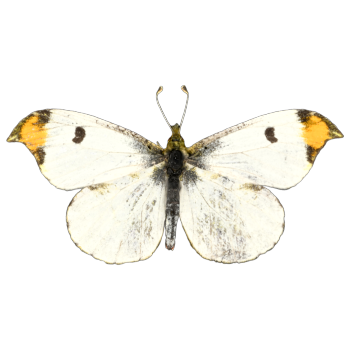
Anthocharis scolymus
The yellow tipped butterfly, scientific name Anthocharis scolymus Butler, belongs to the family Papilionidae in the order Lepidoptera. It is a butterfly with pointed forewings and three black spots arranged in a triangle shape. It is widely distributed in various regions.

Golden Phoenix Butterfly
The golden phoenix butterfly is an animal belonging to the family Papilionidae in the order Lepidoptera. The golden butterfly is a medium-sized butterfly with a wingspan of 70-84 millimeters. The underside of the wings is black brown with black veins, and the wing chambers have yellow spots; The base of the dorsal surface of the forewings is dark yellow, with a black sub outer edge and a row of small yellow spots inside; The posterior wing has a black broad border in the sub outer edge area, gray blue stripes on the inner side, yellow stripes on the outer side, and an orange red circular spot in the buttock area. The posterior wing has a pair of slender caudal processes. The golden phoenix butterfly is also known as the yellow phoenix butterfly, fennel phoenix butterfly, or carrot phoenix butterfly.
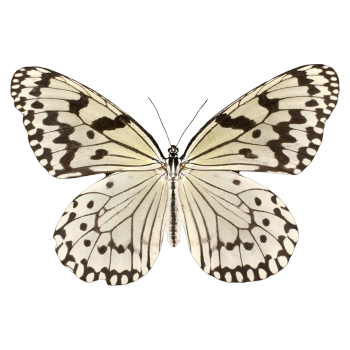
Idea leuconoe
Idea leuconoe is a species of insect in the family Nymphalidae, belonging to the order Entomophthorales. It is also known as the Great White Spot Butterfly. Mainly distributed in Taiwan, Diaoyu Islands, Malay Peninsula, Indonesia, Japan and other places in China.

Green Phoenix Butterfly
The Green Butterfly, scientific name Graphium sarpedon, is a species of butterfly in the family Papilionidae, also known as the Camphor Green Butterfly, Green Banded Camphor Butterfly, Blue Banded Green Butterfly, or Blue Banded Yellow Butterfly. It can be classified into spring and summer types, with the spring type being slightly smaller and the wing surface having slightly wider blue-green stripes. More than one year and overlapping generations, overwintering as pupae. Adults appear from March to October and are visible throughout the year in tropical regions. The green swallowtail butterfly has strong flying ability and likes to visit flowers and suck honey. It often moves in damp and open areas at low altitudes, and is also common in gardens, streets, and forest spaces. Mainly distributed in Asia and Oceania. The hosts are mostly plants of the Lauraceae family.

kaniska canace
The Liuli Nymphalidae is an arthropod belonging to the family Nymphalidae in the order Lepidoptera, also known as the Blue banded Nymphalidae. The outer edge of the adult's forewings protrudes from the apex to the M1 vein end, and from the Cu2 vein end to the posterior horn, forming a wavy circular arc shape; The front of the wings is black brown, with one white spot at the sub tip; There is a gray blue broad band running through the outer middle area of the two wings, which forms a "Y" shape on the front wing and a black dot on the gray blue broad band on the back wing. The M3 vein on the outer edge of the hind wing protrudes in a toothed shape. The base half of the dorsal wing is black brown, the end half is brown, and there is one brown white spot in the middle compartment of the hind wing.

Neptis hylas
The Central Sailer (scientific name: Neptis hylas, English common name: Common Sailer, alias: Ryukyu Three line Butterfly, Thin winged Grass Butterfly, Wood Three line Butterfly, Autumn Butterfly) is also known as the Bean Ring Butterfly in Taiwan. It belongs to the Nymphalidae family and is a species of the Ring Butterfly genus. Widely distributed in the Eastern Ocean, including India to Japan and Southeast Asia. The mode of origin is Guangdong, China. Adults are visible throughout the year and love to visit flowers, absorb decay, and water; The host of larvae is mainly leguminous plants.
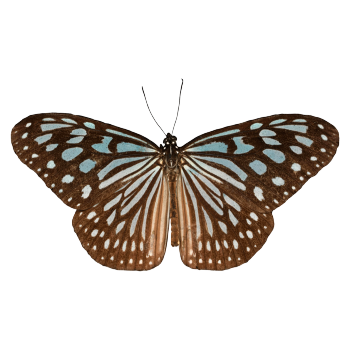
Ideopsis similis
The wingspan of the proposed spotted butterfly ranges from 75.0 to 85.0 mm. There are white spots on the head and chest. The front and rear wings are black brown with translucent light blue spots. The forewings have 5 longitudinal bands extending outward from the base of the wing, and 10 spots on the outer side of the longitudinal bands. There are three small longitudinal bands in the interior of the hind wing, surrounded by six spots or longitudinal bands. There are horizontal spots on the sub terminal and terminal parts of the front and rear wings.

Athyma selenophora
The Athyma selenophora (Latin name: Athyma selenophora) is a species of butterfly in the family Nymphalidae, distributed in Hainan, Guangdong, Guangxi, Yunnan, and Fujian. Belonging to a multi generational butterfly species. Adult butterflies have a habit of visiting flowers, and in the early stages of larvae, they have a habit of wrapping silk around feces particles to make rod-shaped "feces towers" to hide.

Pale white spotted bean pink butterfly
Colias erate is a butterfly belonging to the family Colubridae and the genus Colubridae. The male butterfly has yellow wings, with wide black stripes on the outer edge of the forewings and black stripes on the outer edge of the hindwings that are often connected in a row. There are two types of female butterflies: type one has a pale yellow green or light white wing surface (with the same markings as male butterflies); The other type has a yellow wing surface, identical to that of male butterflies. The color on the underside of the wings is relatively light, with one column of dark spots at the sub end.

Popular Models
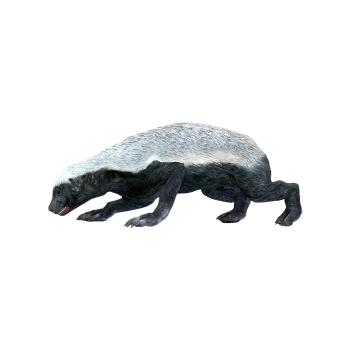
Honey Badger (3D animated model)
194 View
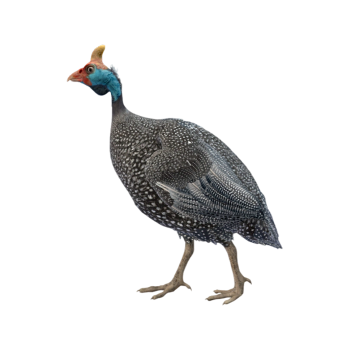
Guinea fowl (3D animated model)
165 View
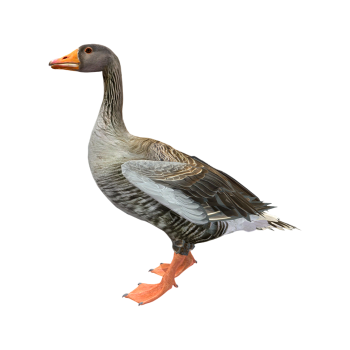
Wild Goose (3D animated model)
187 View
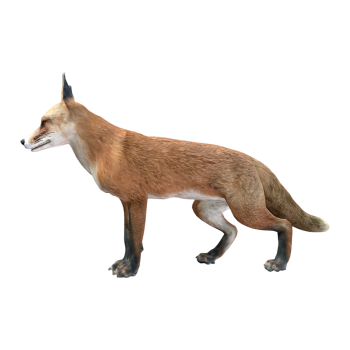
Red Fox (3D animated model)
155 View
Random Model

2011 Sports Camera Replay XD 1080 MINI
1009 View



Kalak sailing ship
848 View



Ford F-150 Raptor (2021 model)
950 View

